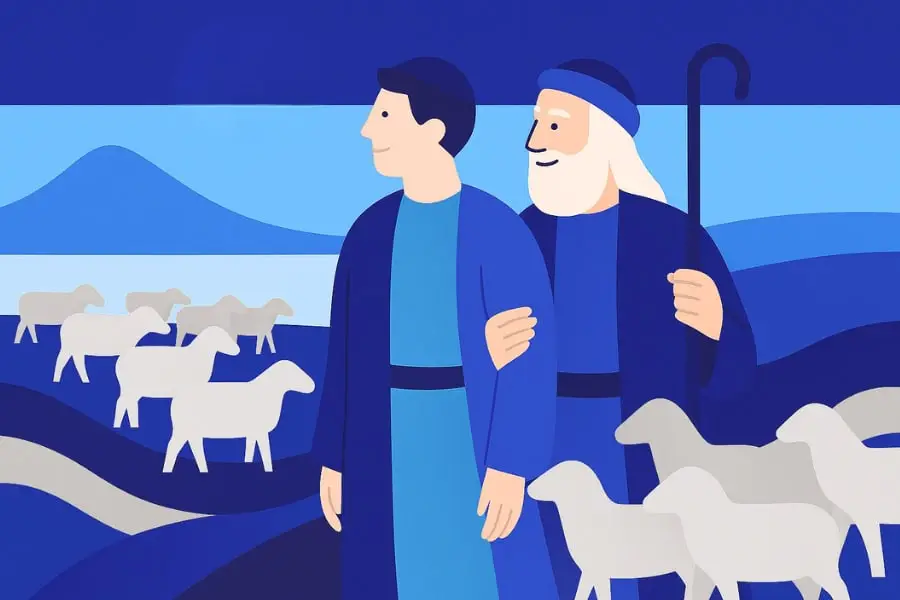
In her new blog on Parashat Vayelech, Rabbanit Sarah Segal-Katz turns to the figure of Moses, the “faithful shepherd,” who takes leave of the people and of leadership at the end of his life. First introduced as a shepherd at the burning bush, Moses continues to bear responsibility for Israel as their shepherd until his final moments. This reading highlights the biblical roots of spiritual care: leadership defined not by coercion or authority alone, but by guidance, accompaniment, and support in times of crisis as well as growth.
At the center of the Parashah stands the transfer of leadership to Joshua and the blessing “Ḥazaq ve-Ematz—be strong and courageous.” Unlike Moses, who at the beginning of his own mission received no such words of encouragement, he now bestows upon his successor what he himself once lacked. The blessing signals continuity of leadership and the need not only for outward strength but also for inner resilience.
The blog also reflects on the women whose presence shaped Moses’ journey—Yocheved, Miriam, Pharaoh’s daughter, Zipporah, and the daughters of Zelophehad—without whom his survival and leadership would not have been possible. A gender-sensitive lens reveals that leadership never arises in solitude, but within a web of support and challenge.
As Moses confronts his own mortality and transition, the parashah—read during the Ten Days of Repentance—echoes the call of Torah and the prophets: to choose the good, to return, and to live with responsibility and compassion. Thus Moses remains a paradigmatic figure of leadership—uniting law and spirit, authority and humility, blessing and inspiration for generations.