This year, Sukkot falls precisely on October 7—a collision of calendars that places us squarely in the breach, holding a tangle of feelings. How does one fulfill the mitzvah of joy in such a season? How do we carry a fierce hope for the hostages’ return amid an ongoing war? On the first day of the Chag I offered a dvar Torah at “The Kehilah,” Riverdale, that sought meaning through the holiday’s central motifs.
I revisited the classical tensions of keva and arai—the fixed and the transient; security and belonging on the one hand, unsettlement and estrangement on the other. Over the past two years we have learned that transience dwells within the home itself: in Israel’s southern communities and across Israel at large, in the ripples that reach neighboring geographies, and within Jewish life in the United States and the Diaspora. Precisely here the sukkah may serve as counter-symbol and medicine: a space open to sky and guests, a disciplined practice of stepping beyond heaviness, and a ritual attunement to the Ananei ha-Kavod—the clouds of divine presence—recalling Israel’s desert encampments. As Shir ha-Shirim Rabbah teaches, the sukkah is the Shekhinah’s embrace: “His left hand is under my head, and His right hand embraces me.”
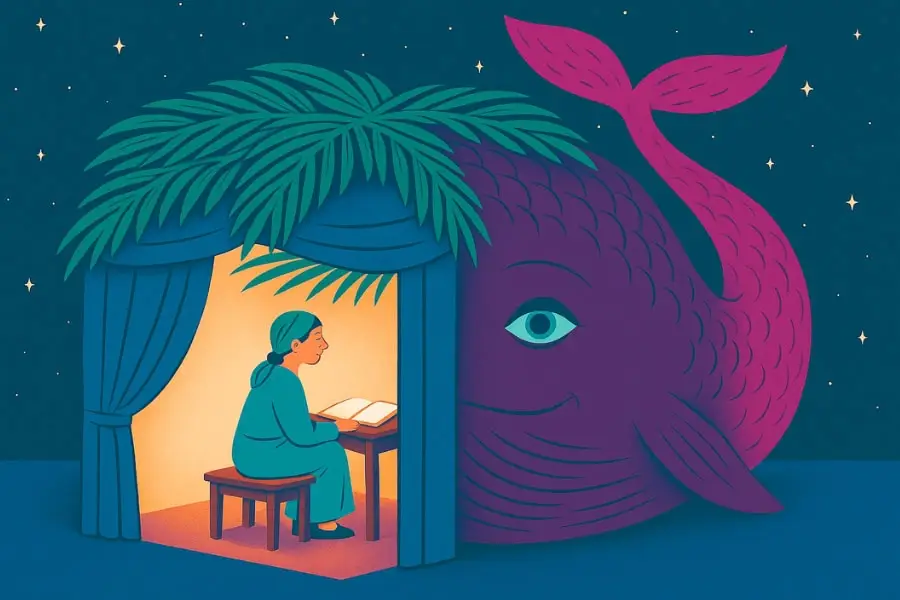
Each Sukkot we also pray, “May it be Your will that next year I merit to dwell in the Sukkah of Leviathan.” The mythic image licenses imagination beyond the here and now. Following Prof. Haviva Pedaya, the span from October 7, 2023 to 2025 may be read as a parenthesis—a hole in time, a liminal no-man’s-land. The Leviathan is both the great fish that swallowed Jonah and, since Hobbes, a figure for the state. To set Leviathan beside the sukkah is to acknowledge two forces within us: the longing for durable home and the consciousness of fragility; power and vulnerability.
How, then, to keep the commandment of joy? Perhaps by holding the contradictions together—hope and anxiety—praying for the hostages’ return, and trusting a path from rupture to rebuilding, from crisis to healing: “May the Merciful One raise up for us the fallen sukkah of David; may the Merciful One spread over us a sukkah of compassion and peace.”