לקריאת המאמר בעברית במגזין גלויה | Originally published in Hebrew in Gluya
The upsherin (or chalakeh, meaning haircut in Arabic, in the Middle East) is a traditional Jewish ceremony marking a boy’s first haircut at the age of three. This tradition originated among kabbalistic circles in sixteenth-century Safed, and from there, it spread to Jewish communities in Arab countries and Hasidic communities in Europe, where it became known in Yiddish as upsherin. Professor Yoram Bilu wrote about the Jewish child’s transition from the brit milah (in addition to circumcision, milah also means “word”) to the world of the written and spoken word at the age of three; indeed, this is the age at which Jewish children are deemed ready to begin their education, entering the traditional cheder where they will be introduced to letters and reading.
The age of three is a critical developmental stage that marks the transition from infancy to childhood. The child begins to develop self-awareness and learning abilities and starts to absorb the surrounding culture. The custom of shaving the hair and leaving the peyot (sidelocks) symbolizes this new stage of entering Jewish culture and learning how to keep the mitzvot, a ten-year process prior to accepting the obligations of the mitzvot at the age of Bar Mitzvah, 13. The ceremonial nature of cutting the infant’s hair in a way that clearly identifies the child as a “boy” and leaves the sidelocks unshaven according to halakhic standards (they can be long or short) helps convey to the surrounding world that this child is identified as male and accordingly will be subject to certain halakhic obligations when he reaches the age of mitzvot.
The upsherin ceremony serves as an initial introduction to the world of Torah, tradition, and the mitzvot beyond the child’s growth up to this stage. From this point onwards, religious Jewish parents begin to gently encourage their children to bless and pray according to their age, with expectations growing each year until they mature into fulfilling the mitzvot as adults. Some follow the custom of holding the upsherin ceremony on Lag Ba’Omer on Mount Meron, during the public celebration in memory of Rabbi Shimon bar Yochai. Others endeavor to hold the ceremony close to or after the child’s birthday, but not before.
The upsherin ceremony is not rigid or formal, and the tradition is expressed in various ways that differ from community to community. It is not a mitzvah or halakhah but rather a custom; in some communities, this custom has not taken root and is not observed.
The informal nature of the upsherin ceremony allows those who wish to do so to develop its basic elements into a symbolic expression of the unique transition in their child’s life. This presents a wonderful opportunity to cultivate new offshoots of existing traditions and customs, giving them relevance in the modern day. Even people from families for whom the upsherin ceremony was not a tradition passed from generation to generation can connect to its renewed meanings; indeed, it is accessible and available to anyone who wishes to celebrate and mark this moment.
Suggestions for the Upsherin Ceremony
Even if you do not wish to travel to Meron and cut your son’s hair at the foot of Rabbi Shimon bar Yochai’s tomb, various customs and traditions can ensure that the upsherin ceremony is meaningful for all those present.
Planting a Tree
Planting a tree is directly connected to the child’s age and the symbolism of this stage as a transition from infancy (orlah) to independence and fertility, as the Midrash Tanchuma learns from the biblical verses concerning planting a tree in the Land of Israel.
When you come to the land and plant any kind of fruit tree, you shall regard its fruit as forbidden. For three years it will be forbidden to you; it shall not be eaten. In the fourth year, all its fruit shall be holy, a praise to the Lord. In the fifth year, you may eat its fruit, so that it will increase its yield for you; I am the Lord your God.
(Leviticus 19:23-25)
You shall plant and consider it forbidden. The text speaks of a child. For three years, he will be like an uncircumcised fruit—unable to converse or speak. In the fourth year, all his fruit will be holy — his father dedicates him to Torah, praising God. What is the meaning of praising? When he praises the Holy One, blessed be He. And in the fifth year, you may eat its fruit—from the time he is obligated to read from the Torah. From here on, may his yield increase for you. Based on this, our sages taught: At five years old, a child should begin studying the Bible; at ten years old, the Mishnah. (Tanchuma, Kedoshim, 14)
Licking Letters Covered in Honey
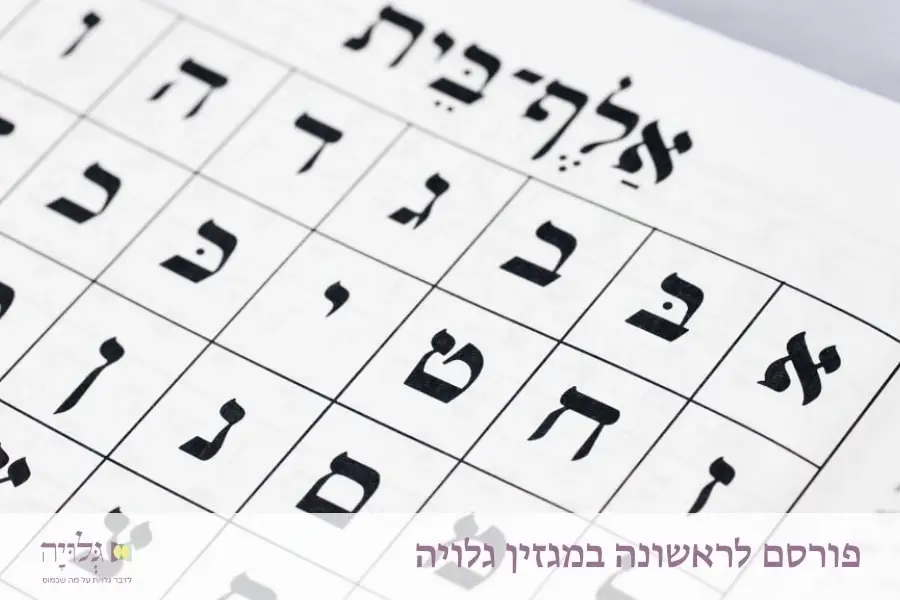
In the Ashkenazi tradition, to instill a love for Torah study, it was customary to have children lick honey-covered letters during the ceremony marking the beginning of their education. Today, too, you can prepare a board with the letters of the Hebrew alphabet coated in honey, read them together with the child, and let the child lick the letters (you can also offer this to others present at the ceremony).
Presenting the Child with a Tallit Katan
You can give a child a new tallit katan with tzitzit and teach him to recite the blessing:
Blessed are You, Lord our God, King of the universe, who has sanctified us with His commandments and commanded us to wrap ourselves in tzitzit.
You can also teach the child to recite the blessing for a new garment:
Blessed are You, Lord our God, King of the universe, who has granted us life, sustained us, and enabled us to reach this occasion.
After this, some say:
I will greatly rejoice in the Lord, my soul shall be joyful in my God; for He has clothed me with garments of salvation, He has covered me with the robe of righteousness, as a bridegroom decks himself with ornaments, and as a bride adorns herself with her jewels.
(Isaiah 61:10)
Verses of Blessing Before the Upsherin (Haircut)
It is recommended that those present bless the child before the symbolic act of cutting the hair. The blessings and verses can be divided among family members, such as grandparents, siblings, aunts and uncles, and so on. Additionally, the audience can be included in a communal reading.
Blessing the Children:
May God make you like Ephraim and Manasseh; May the Lord bless you and protect you: May the Lord shine His face upon you and be gracious to you; May the Lord lift His face toward you and grant you peace; And they shall place My name upon the children of Israel, and I will bless them.
Additional Blessings:
May it be the will of our Father in Heaven that He places His love in your heart. And may the fear of God be upon you all the days of your life so that you do not sin. May your desire be for Torah and mitzvot, may your heart meditate on understanding, may your mouth speak wisdom, and may your tongue sing praises. May your eyes shine with the light of Torah, and may your face radiate like the brightness of the sky. May your lips express knowledge, and may your innermost being rejoice in integrity. May your steps hasten to hear the ancient words, and may you fulfill them: “And he shall be like a tree planted by streams of water, which yields its fruit in its season, and whose leaf does not wither; and whatever he does shall prosper.”
And:
The spirit of the Lord shall rest upon him, a spirit of wisdom and understanding, a spirit of counsel and might, a spirit of knowledge and fear of the Lord. And may He grant you righteous sons and daughters who engage in Torah and mitzvot all their days. May your fountain be blessed. And may He provide you with your livelihood in tranquility and abundance from His generous hand. Livelihood that allows one to be available to serve God. May your good health be constant, and may you be inscribed for a good and long life among all the righteous of Israel, Amen.
May it be Your will, Lord our God and God of our ancestors, that just as You have granted this son the merit to fulfill the sacred custom of Israel, so too may You grant him the merit of Torah, mitzvot, a wedding canopy, and a life of prosperity and sustenance. May the verse be fulfilled in him, “For through me your days will be multiplied, and years of life will be added to you,” and “For length of days and years of life and peace will they add to you.” Amen, may it be Your will.
The angel who has redeemed me from all evil, bless the lads; and let my name and the name of my fathers, Abraham and Isaac, be called on them; and may they grow into a multitude in the midst of the earth.
(Genesis 48:16).
And may God Almighty bless you and make you fruitful and multiply you, and you shall become a congregation of peoples (Genesis 28:3). From the God of your father, and He will help you, and from the Almighty, and He will bless you with blessings of the heavens above, blessings of the deep that lies below, blessings of the breasts and of the womb
(Genesis 49:25).
When you lie down, you will not be afraid; you will lie down, and your sleep will be sweet.
(Proverbs 3:24)
May the Lord protect you from all evil; may He guard your soul. May the Lord guard your going out and your coming in from now and forevermore.
(Psalms 121:7‒8)
Translated by Joshua Amaru