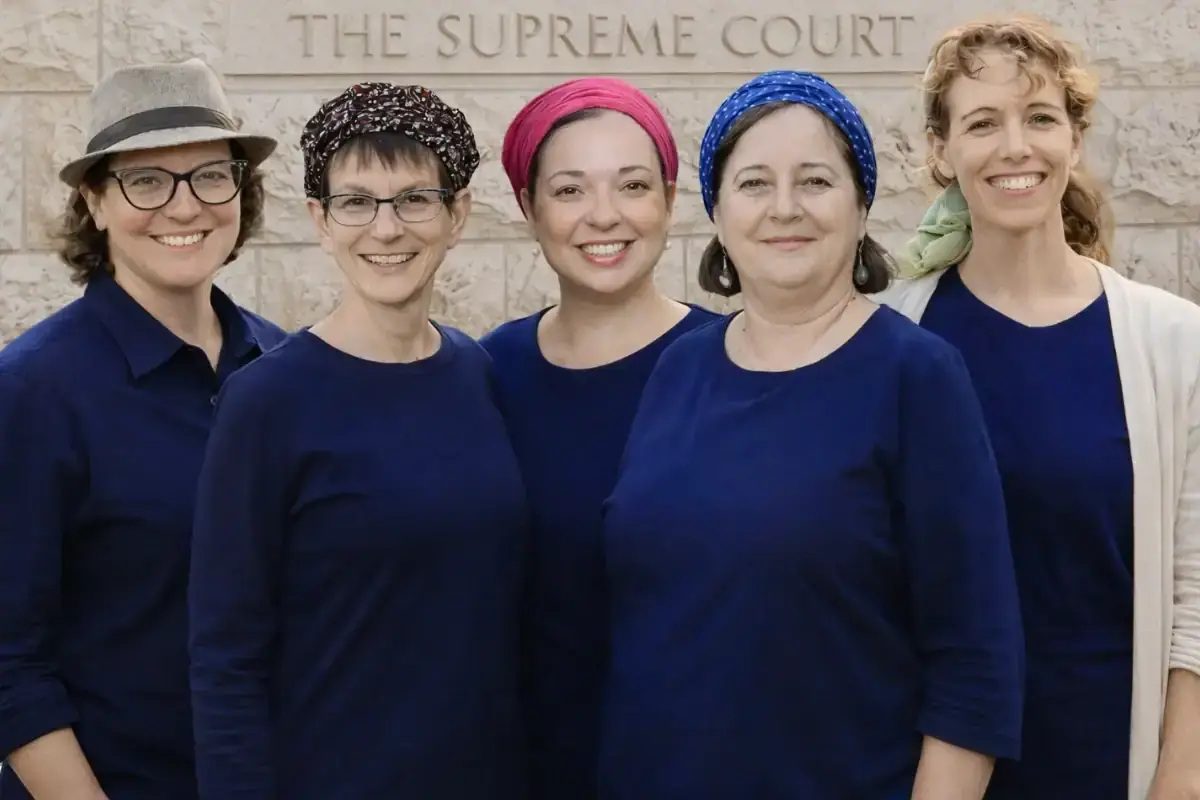

In an op-ed published in Haaretz, Rabbanit Sarah Segal-Katz addresses the Chief Rabbinate’s request for a further hearing and for a stay of execution with respect to the July ruling. In that decision, issued by a panel of Justices Noam Sohlberg, Dafna Barak-Erez, and Ofer Grosskopf, the High Court of Justice (HCJ) held that barring women from the halakhic examinations administered by a state institution constitutes unlawful discrimination and that women must be permitted to sit the exams.
Segal-Katz notes that the Rabbinate’s submission exhibits what classical Jewish law calls “modeh be-miktzat”—a Talmudic legal concept denoting a partial admission by a defendant that, by its nature, undermines total denial and strengthens the claimant’s case. By its own terms, the Rabbinate’s filing acknowledges that the judgment is implementable, thereby eroding the foundations of its objections. For example, the contention that the exams are intended solely for candidates seeking kosher rabbinate certification (kosher rabbanut, “koach/kosher rabbanut”) does not withstand scrutiny: for years, individuals with no intention of ordination have taken these exams, and the resulting certificates have served as credentials for employment, professional-development credits, academic equivalency, and eligibility for public tenders. Accordingly, the petitioners did not seek semikhah (ordination) but simply the right to sit state-run exams within a single public framework.
Segal-Katz further explains that the Rabbinate’s proposal of a separate or narrowed track for women—e.g., permitting exams only in Shabbat and niddah—both concedes the feasibility of examining women and, at the same time, revives a “separate but equal” model that the HCJ has already rejected. If the relevant criterion is public relevance, then women require halakhic knowledge across the full range of subjects; if the criterion is personal applicability, men too routinely sit for exams in areas that are not practically operative for them.
Alongside the social reality—women teaching halakhah, heading batei midrash, fielding halakhic queries, and publishing scholarly works—Segal-Katz concludes: opening the examinations to women is not a “gesture,” but the rectification of a longstanding injustice and the duty of a democratic state toward its citizens. The judgment has been issued; it is now to be implemented.